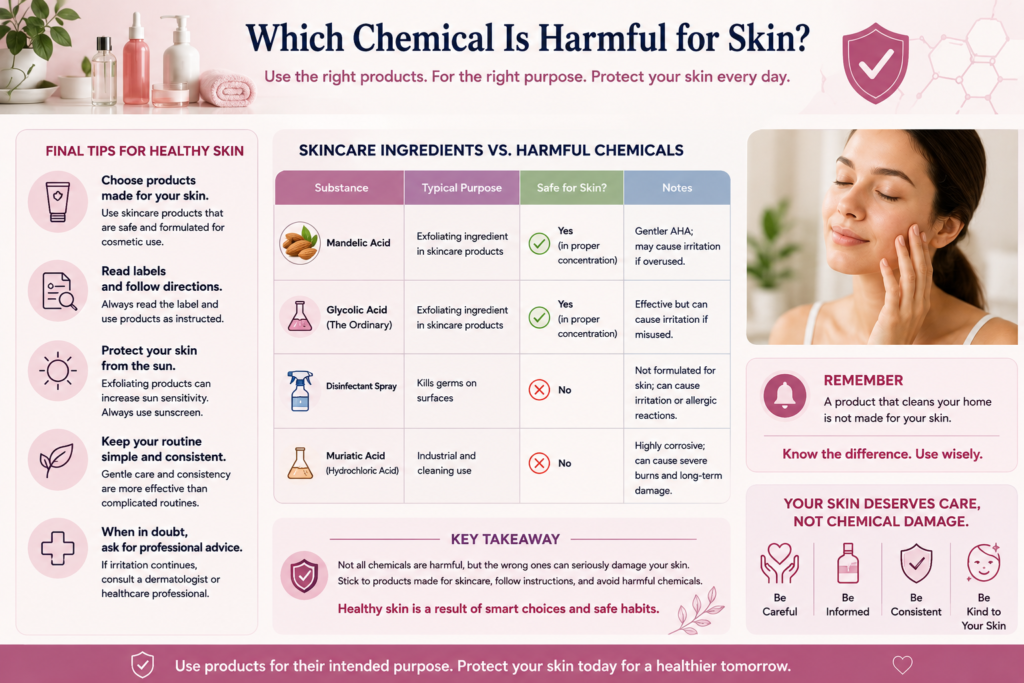
Which Chemical Is Harmful for Skin? A Complete Guide
Our skin comes into contact with many different chemicals every day, from skincare ingredients and cosmetics to household cleaning products. While some chemicals are specifically formulated to be used safely on the skin, others can cause irritation, dryness, burns, or other damage when they come into contact with it.
Understanding the difference between skincare ingredients and chemicals intended for other purposes is important for maintaining healthy skin. For example, mandelic acid can be used in properly formulated skincare products, while substances such as muriatic acid and household disinfectant spray are not intended for direct skin application.
So, which chemical is harmful for skin? The answer depends on the substance, its concentration, how it is used, and how long the skin is exposed to it. This guide explains some commonly discussed chemicals and how to protect your skin from unnecessary irritation.
What Makes a Chemical Harmful to Skin?
Almost any substance can potentially irritate the skin under the wrong circumstances. A chemical may become harmful because of its concentration, exposure time, frequency of use, or the sensitivity of an individual’s skin.
Common signs of chemical irritation include:
- Redness or burning sensation
- Itching or discomfort
- Excessive dryness
- Peeling or flaking
- Increased sensitivity
- Swelling or irritation
Some chemicals can cause much more serious reactions, particularly substances that are highly acidic, alkaline, corrosive, or designed for industrial or household cleaning purposes.
This is why a product being described as a “chemical” does not automatically mean that it is dangerous. Skincare products also contain chemicals, but they are formulated and tested for their intended cosmetic use.
Is Mandelic Acid Harmful for Skin?
Mandelic acid is an alpha hydroxy acid (AHA) commonly found in exfoliating skincare products. It is derived from bitter almonds and has a relatively larger molecular structure than some other AHAs.
Because of this, mandelic acid is often considered a gentler exfoliating option when used in an appropriately formulated product. It can help remove dead skin cells from the surface of the skin and improve the appearance of uneven texture.
However, “gentler” does not mean completely risk-free.
Using mandelic acid too frequently or choosing a product that is too strong for your skin may cause dryness, irritation, redness, or increased sensitivity. It is important to follow the product’s directions rather than assuming that more frequent use will produce better results.
If you are new to exfoliating acids, introducing one product at a time can make it easier to notice how your skin responds.
What About Glycolic Acid The Ordinary?
Glycolic acid The Ordinary is another frequently searched skincare term because The Ordinary offers glycolic-acid-based products.
Glycolic acid is an AHA with a smaller molecular structure than mandelic acid. It is commonly used in skincare products designed to exfoliate the skin and improve the appearance of texture.
Like other exfoliating acids, glycolic acid can cause irritation if it is overused. Applying it more often than recommended, combining several strong exfoliating products, or using it on already irritated skin may increase the likelihood of discomfort.
When using an exfoliating product, always read its instructions and pay attention to how your skin feels. Persistent burning, significant redness, or worsening irritation is a reason to stop using the product and seek advice from a parent or guardian and a healthcare professional if needed.
It is also important to protect your skin from the sun because exfoliation can make skin more sensitive to sunlight. Using appropriate sun protection during the day is an important part of a skincare routine.
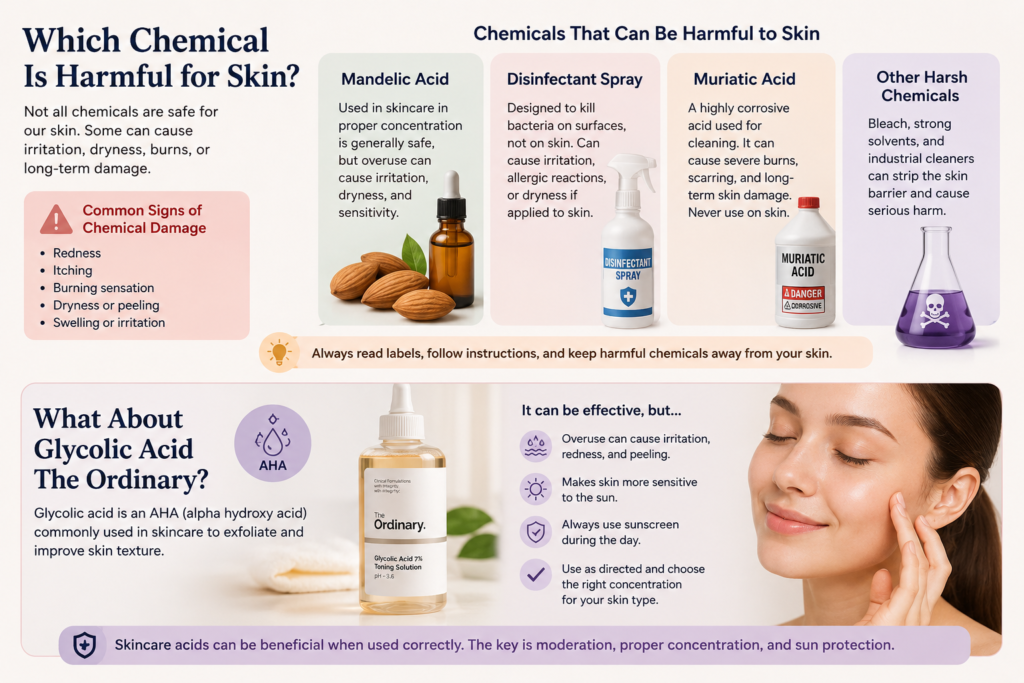
Is Disinfectant Spray Harmful to Skin?
A disinfectant spray is designed to disinfect surfaces, not to function as a skincare product.
Many household disinfectants contain ingredients intended to kill or reduce microorganisms on surfaces. These formulations are not designed for direct application to the skin and may cause irritation or other reactions if they come into contact with it.
For this reason, disinfectant spray should never be used as a substitute for handwash, facial cleanser, or skincare products.
If disinfectant accidentally gets onto your skin, follow the product’s safety instructions. In general, contaminated skin should be rinsed thoroughly with plenty of water. If irritation continues or the exposure was significant, tell a trusted adult and seek appropriate medical advice.
The key point is simple: a product that is safe for cleaning a countertop is not necessarily safe for your skin.
Why Is Muriatic Acid Dangerous for Skin?
Muriatic acid is a common name for hydrochloric acid, which is a highly corrosive substance used for certain cleaning and industrial applications.
Unlike cosmetic exfoliating acids, muriatic acid is not a skincare ingredient. Contact with this type of corrosive substance can cause serious chemical injury to skin and eyes.
It should never be intentionally applied to the skin, used as a DIY exfoliant, or included in homemade skincare recipes.
This distinction is particularly important when researching acids online. The word “acid” appears in both skincare and industrial chemistry, but that does not mean all acids have the same properties or are interchangeable.
A cosmetic product containing a carefully formulated acid is very different from a concentrated industrial or household chemical.
Skincare Acids vs. Household Chemicals
One of the biggest misunderstandings about skincare is assuming that all chemicals with similar names can be used in the same way.
For example:
| Substance | Typical Purpose | Intended for Skin? |
|---|---|---|
| Mandelic acid | Cosmetic exfoliation | Yes, when properly formulated |
| Glycolic acid | Cosmetic exfoliation | Yes, when properly formulated |
| Disinfectant spray | Surface disinfection | No |
| Muriatic acid | Cleaning/industrial applications | No |
The concentration and formulation are extremely important. A professionally formulated skincare product is created with a particular application, concentration, packaging, and usage instructions in mind.
Household and industrial chemicals are manufactured for completely different purposes.
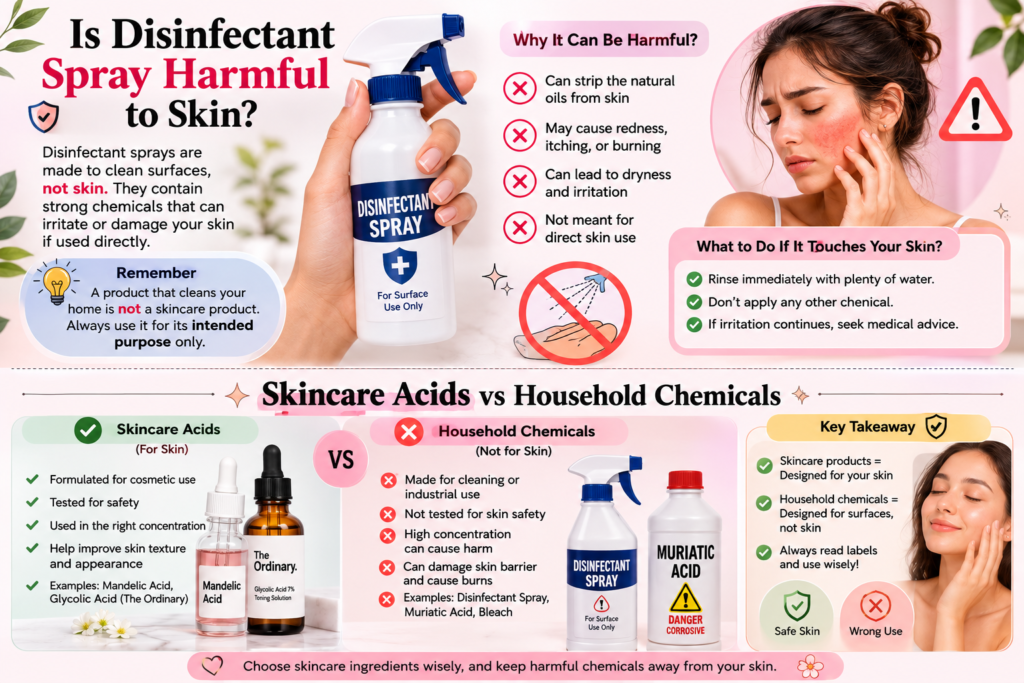
Chemicals That Can Irritate Sensitive Skin
Even ingredients designed for skincare can cause irritation in some people. Exfoliating acids, fragrances, alcohol-containing products, and certain preservatives may be uncomfortable for individuals with sensitive skin.
This does not necessarily mean that these ingredients are universally harmful. Skin reacts differently depending on individual sensitivity and the specific formulation.
If your skin frequently becomes irritated, keeping your routine simple may be helpful. A gentle cleanser, moisturizer, and appropriate daytime sun protection can provide a basic foundation without requiring numerous active ingredients.
Avoid adding several new active products at the same time. If your skin reacts, introducing products individually makes it easier to identify the likely cause.
Common Mistakes That Can Make Skincare Harmful
Sometimes the problem is not the ingredient itself but the way it is used.
1. Using too many active ingredients
Combining several exfoliating products can increase irritation. More active ingredients do not automatically mean better skincare.
2. Applying products too frequently
Following the recommended usage is important. Using a product more often than instructed can compromise the skin barrier.
3. Using household chemicals on the skin
Cleaning products, disinfectants, and industrial chemicals should never be treated as skincare products.
4. Ignoring irritation
If a product causes significant burning, swelling, or persistent irritation, continuing to apply it may make the situation worse.
5. Following unsafe DIY skincare trends
Online trends sometimes encourage people to experiment with substances that were never designed for cosmetic use. Avoid putting household or industrial chemicals on your skin simply because someone claims they can improve its appearance.
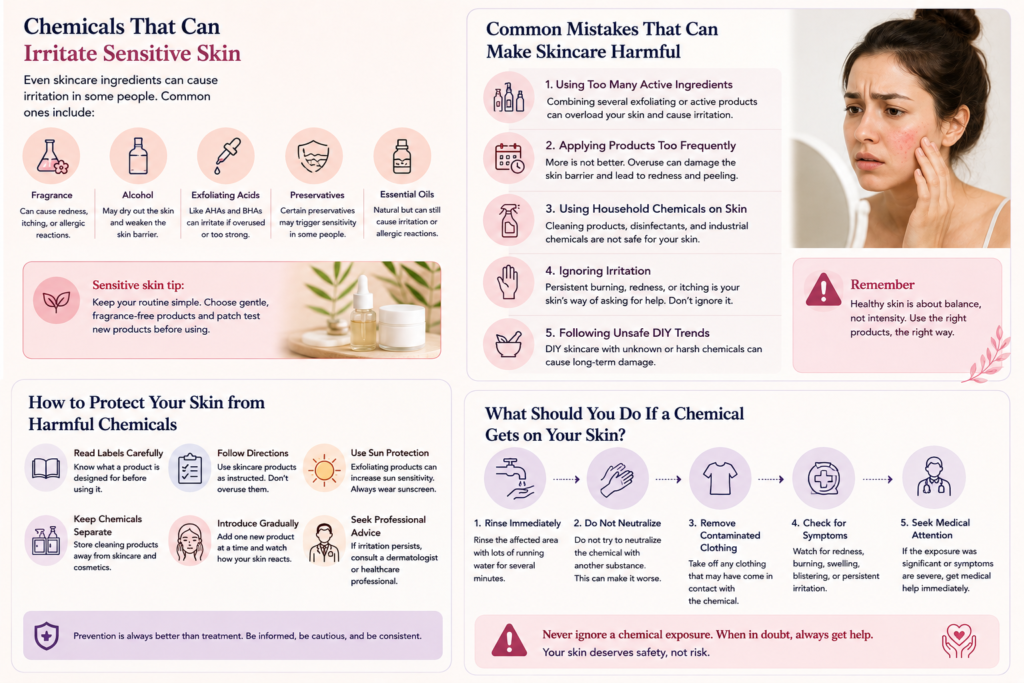
How to Protect Your Skin from Harmful Chemicals
You do not need a complicated routine to protect your skin. A few sensible habits can make a significant difference.
Read product labels: Check what a product is designed for before applying it.
Follow directions: Use skincare products according to their instructions rather than increasing the amount or frequency yourself.
Do not mix random chemicals: Household cleaning products should never be mixed or experimented with for skincare purposes.
Keep cleaning products away from cosmetics: Store household chemicals separately from skincare and personal-care products.
Use sun protection: Exfoliating products can increase sensitivity to sunlight, making daytime sun protection particularly important.
Introduce new products gradually: Adding one new skincare product at a time makes it easier to monitor your skin’s response.
Ask for professional advice when necessary: Persistent or severe skin irritation should be assessed by a qualified healthcare professional.
What Should You Do If a Chemical Gets on Your Skin?
Accidental exposure can happen, especially with household cleaning products. The appropriate response depends on the chemical involved, so always check the product label and safety instructions.
For many chemical exposures, promptly rinsing the affected skin with plenty of running water is an important first step. Do not attempt to neutralize a chemical by applying another chemical to your skin, as this can create additional problems.
If the substance is corrosive, the exposure is significant, or symptoms such as severe pain, swelling, blistering, or persistent irritation develop, tell a trusted adult immediately and seek medical attention.
Do not try to treat a serious chemical exposure with skincare products or home remedies.
Final Thoughts
So, which chemical is harmful for skin? There is no single answer because different substances have very different properties and risks.
Ingredients such as mandelic acid and glycolic acid can be useful in properly formulated skincare products when used according to their instructions. However, products such as disinfectant spray and muriatic acid are designed for purposes outside skincare and should not be applied to the skin.
The most important rule is to understand what a chemical is designed for before using it. A cosmetic ingredient should come from a properly formulated skincare product, while household and industrial chemicals should remain in their intended applications.
Healthy skincare is not about using the strongest ingredient available. It is about choosing appropriate products, following instructions, avoiding unnecessary experimentation, and paying attention to how your skin responds.
Frequently Asked Questions
Is mandelic acid harmful to skin?
Mandelic acid can cause dryness or irritation if overused, but it is commonly used in properly formulated cosmetic products as an exfoliating ingredient. Always follow the product’s instructions.
Can disinfectant spray be used on skin?
No. Disinfectant sprays are formulated for surfaces and should not be used as skincare or applied directly to the skin.
Is glycolic acid safe for skincare?
Glycolic acid is commonly used in cosmetic exfoliating products. However, it can irritate skin when overused or used incorrectly, so follow the product directions.
Is muriatic acid safe for skin?
No. Muriatic acid is a corrosive form of hydrochloric acid and is not intended for skincare. Skin exposure can cause serious chemical injury.
What is the most important way to avoid chemical skin damage?
Use products only for their intended purpose, follow their instructions, avoid household or industrial chemicals on the skin, and seek professional help after significant chemical exposure.