How to Market a Product?
Marketing a product successfully means getting it in front of the right people, communicating its value clearly, and giving customers a reason to choose it. Whether you are launching a completely new product or trying to increase sales of an existing one, a well-planned marketing strategy can make a significant difference.
Many businesses make the mistake of focusing only on advertising. However, effective product marketing starts much earlier. You need to understand your customers, study competitors, define your product’s benefits, select the right marketing channels, and measure the results.
An ad agency can support businesses with campaign planning and advertising, but the foundation of successful product marketing is having a clear strategy. Let’s look at the important steps you can follow.
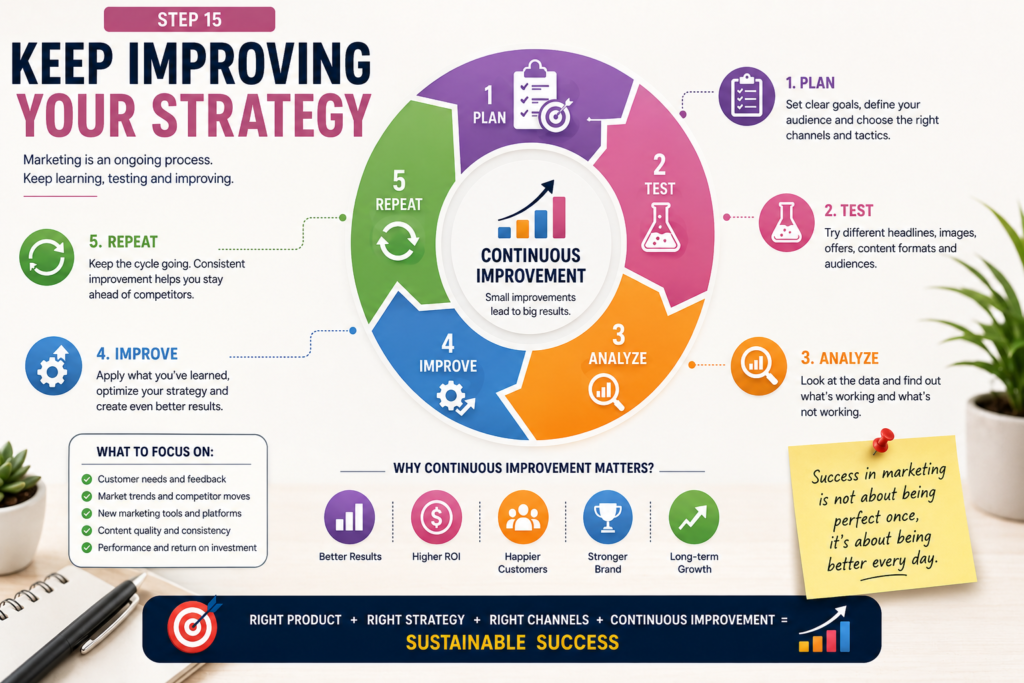
1. Understand Your Target Audience
The first step in marketing any product is knowing who is most likely to buy it. Your product may appeal to a particular age group, profession, location, interest, or lifestyle.
Start by answering a few basic questions:
- Who needs this product?
- What problem does it solve?
- What motivates customers to purchase it?
- What concerns could stop them from buying?
- Where do they usually discover products?
- What price are they comfortable paying?
Creating a basic customer profile can help you develop marketing messages that feel relevant. Instead of trying to appeal to everyone, focus on the audience most likely to become customers.
2. Research Your Competitors
Competitor research helps you understand what is already available in the market. Look at competing products, prices, packaging, websites, social media presence, customer reviews, and promotional strategies.
You do not need to copy competitors. Instead, identify opportunities to differentiate your product.
For example, perhaps competitors offer similar products but have complicated websites. You could make the buying process simpler. Maybe they focus heavily on price while your product has a particular feature or benefit that deserves more attention.
Your goal is to understand the market and find your own position within it.
3. Define Your Unique Selling Proposition
Customers need a clear reason to choose your product. Your unique selling proposition, or USP, explains what makes your product valuable or different.
A good USP should focus on a meaningful customer benefit. It could be convenience, quality, design, performance, ingredients, durability, affordability, or another characteristic that matters to your target audience.
Avoid making vague claims such as “the best product” without explaining why. Specific benefits are easier for customers to understand and remember.
4. Build a Strong Brand
Product marketing becomes more effective when customers can recognize and remember your brand.
Your branding should remain consistent across your website, packaging, social media profiles, advertisements, and other promotional materials. This includes your logo, colors, typography, imagery, tone, and key messages.
A strong brand does not necessarily require an expensive design. It requires consistency and a clear identity.
When customers repeatedly see the same recognizable brand, it becomes easier to build familiarity and trust.
5. Create a Product-Focused Website
Your website can act as the central destination for your marketing campaigns. When someone discovers your product through an advertisement or social media post, they should be able to find detailed information quickly.
A product page should clearly communicate:
- What the product is
- Who it is for
- Its main benefits
- Important features
- Price and purchasing information
- Frequently asked questions
- Reviews or testimonials when available
- How customers can contact the business
Use clear images and straightforward language. Avoid filling the page with unnecessary information that makes it difficult for customers to understand the product.
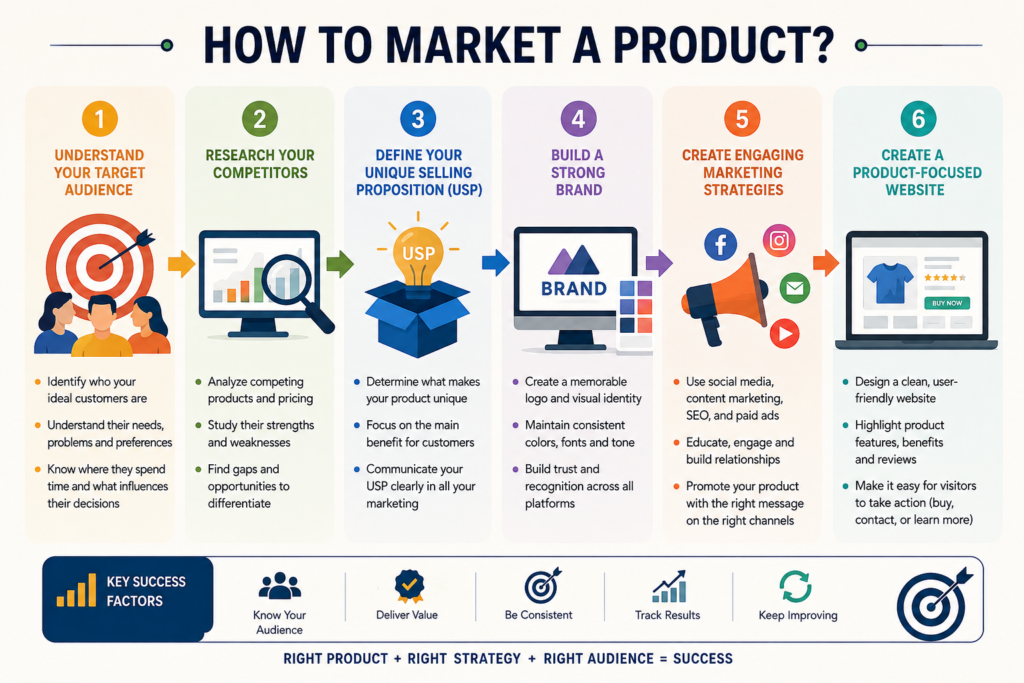
6. Use Social Media Marketing
Social media can help introduce products, demonstrate how they work, answer questions, and build relationships with potential customers.
Your content can include product demonstrations, tutorials, educational posts, behind-the-scenes content, customer experiences, short videos, and product-related tips.
You do not have to make every post promotional. Educational and entertaining content can help people become familiar with your brand before they are ready to purchase.
Businesses with limited internal resources may also work with a social media marketing agency to manage content planning, advertising, audience research, and campaign performance.
7. Invest in Search Engine Optimization
Search engine optimization can help people discover your product when they search for related information online.
Start by researching the phrases your potential customers use. Then create useful product pages, blogs, guides, and FAQs around relevant search intent.
For example, instead of only creating a page titled with the product name, you could publish educational content answering questions customers commonly ask before purchasing.
SEO usually requires consistency and patience. The goal should be to create genuinely useful content rather than inserting keywords repeatedly.
8. Use Paid Advertising
Paid advertising can help businesses reach potential customers more quickly. Search ads, social media advertisements, display campaigns, and other formats can be used depending on the product and audience.
When creating an advertisement, focus on one clear message. Explain the most important benefit and give the viewer an obvious next step.
Your advertisement should also match the landing page. If the ad promises a particular benefit but the landing page does not explain it, customers may leave without purchasing.
Working with an ad agency can be useful when you need help with campaign strategy, creative development, audience targeting, budgeting, and performance analysis.
9. Try Content Marketing
Content marketing allows you to educate potential customers before asking them to buy.
Create content that answers genuine questions related to your product. Depending on your industry, this could include:
- How-to guides
- Buying guides
- Tutorials
- Product comparisons
- Educational blogs
- Videos
- FAQs
- Industry insights
Useful content can attract people who are still researching their options. Over time, this can help your brand become a useful source of information rather than simply another business trying to sell something.
10. Consider Influencer and Creator Marketing
Creators can help businesses introduce products to audiences that already trust their content. However, follower count should not be the only factor you consider.
Look at audience relevance, engagement, content quality, credibility, and whether the creator’s audience matches your target customers.
For example, a smaller creator whose audience is genuinely interested in your product category may be more relevant than a large account with a completely unrelated audience.
Always ensure promotional relationships are disclosed appropriately.
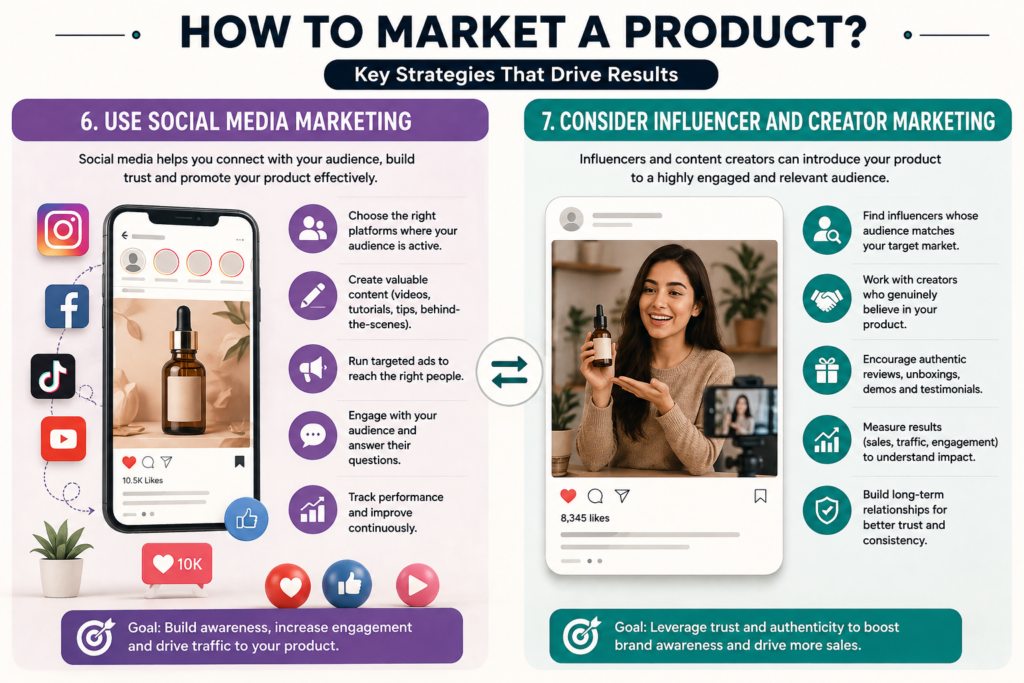
11. Use Local Marketing When Appropriate
If your product is sold through a physical store or your business serves a specific geographic area, local marketing can help you reach nearby customers.
Optimize your business information online, maintain accurate contact details, encourage genuine reviews, and create location-relevant content where appropriate.
Local service ads can be useful for eligible local businesses that want to appear when nearby customers search for relevant services. Their usefulness depends on the business model and the type of customer you are trying to reach.
12. Don’t Completely Ignore Offline Marketing
Although digital channels are important, offline marketing can still support product awareness.
For businesses targeting a broad local audience, billboard advertising can increase visibility in busy areas. A billboard should be simple because people usually have only a short time to notice the message.
Use a memorable headline, recognizable branding, a strong visual, and a simple call to action.
Offline and online campaigns can also work together. Someone might see a billboard and later search for the brand online, so maintaining consistent branding across both channels is important.
13. Encourage Reviews and Recommendations
Customer feedback can influence purchasing decisions. Encourage genuine customers to share their experiences where appropriate.
Reviews can help potential buyers understand how other customers experienced the product. They can also reveal common questions or concerns that your business should address.
Never create fake reviews or misleading testimonials. Authentic feedback is much more valuable for building long-term credibility.
14. Measure Your Results
You cannot improve a marketing strategy if you do not know what is working.
Track metrics that match your goals, such as:
- Website traffic
- Leads
- Sales
- Conversion rate
- Advertising costs
- Cost per acquisition
- Click-through rate
- Social engagement
- Return on advertising spend
Do not focus on every metric at once. Choose the measurements that tell you whether your specific objective is being achieved.
If one campaign produces strong results, you can study what made it successful and use those insights in future campaigns.
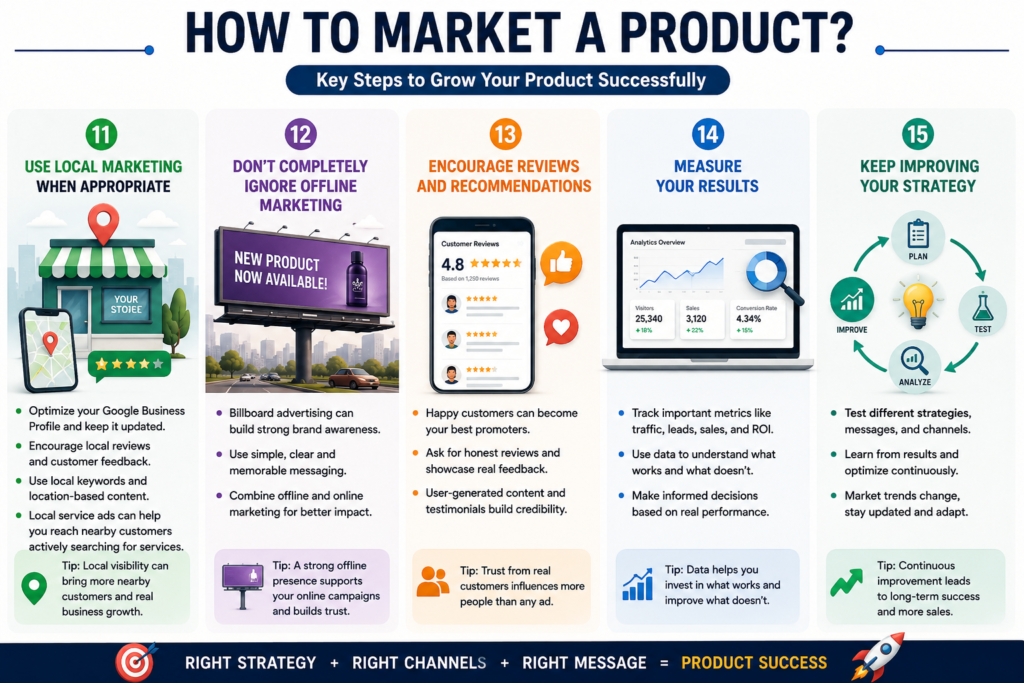
15. Keep Improving Your Strategy
Product marketing is not something you do once and then forget. Customer preferences, competitors, platforms, and market conditions change over time.
Test different headlines, images, offers, content formats, and audiences. Compare the results and keep improving what works.
A digital marketing company can help businesses coordinate SEO, paid advertising, social media, content, analytics, and other online activities when managing everything internally becomes difficult.
The most successful strategies are usually based on continuous learning rather than assumptions.
Conclusion
So, how do you market a product effectively? Start by understanding your target audience and competitors. Define what makes your product valuable, build a recognizable brand, create a useful website, and select marketing channels that match your customers.
Social media, SEO, content marketing, paid advertising, email, creator partnerships, and local marketing can all contribute to product promotion. Traditional methods such as billboard advertising can also support awareness when they fit the target market.
An ad agency can help businesses plan and manage advertising campaigns, but no agency can replace a clear understanding of the product and its customers. The strongest results come from combining a valuable product with clear communication, consistent branding, appropriate marketing channels, and continuous measurement.
FAQs
1. What is the best way to market a product?
There is no single best method for every product. The right strategy depends on your target audience, industry, budget, competition, and marketing objectives. A combination of SEO, social media, content, paid advertising, and other suitable channels can work well.
2. How can I market a new product?
Start with audience research and competitor analysis. Define your product’s USP, create strong product pages, build awareness through relevant channels, collect customer feedback, and measure campaign performance.
3. Is social media good for product marketing?
Yes. Social media can help businesses demonstrate products, educate customers, build awareness, answer questions, and drive traffic to product pages.
4. Should I hire an ad agency?
An ad agency may be useful when you need professional support with advertising strategy, campaign creation, targeting, creative work, or performance tracking. Choose an agency based on relevant experience and measurable capabilities rather than promises of guaranteed results.
5. Are local service ads useful for every business?
Not necessarily. Local service ads are more relevant to eligible businesses that depend on local customers and searches. Product businesses should evaluate whether local intent is important to their sales process.
6. Does billboard advertising help sell products?
Billboard advertising can help increase brand awareness, particularly when the placement reaches a relevant audience. It generally works best when the message is simple and supported by other marketing channels.
7. What does a social media marketing agency do?
A social media marketing agency can assist with content strategy, social media management, paid campaigns, audience research, creative development, and performance reporting.
8. How long does product marketing take to work?
The timeline varies by channel and industry. Paid campaigns can generate traffic quickly, while SEO, content marketing, and brand building generally require more time and consistent effort.
9. Why is SEO important for product marketing?
SEO can help your product and educational content appear when potential customers search for relevant topics, questions, and solutions. It can support long-term organic visibility.
10. Can a digital marketing company market a product?
Yes. A digital marketing company can help with services such as SEO, paid advertising, content marketing, social media, analytics, and conversion optimization, depending on its expertise.